Learning Design Toolkit
This toolkit was designed as part of a Masters in Education (M.Ed.) program. It showcases my knowledge of learning theories and helps me to define which learning theory would best suit your needs.
My instructional design philosophy centers on creating impactful experiences that are responsive, inclusive, and learner centered. I prioritize user-friendly designs that are accessible to all learners, ensuring equitable access to learning materials regardless of ability or background. Moreover, as a big fan of developing technologies, I have adopted using AI in an ethical manner. By responsibly integrating AI, I leverage personalization and efficiency while safeguarding against biases and privacy concerns. My course development approach is iterative, embracing feedback to refine and enhance designs continuously. I believe that collaboration is key to success. I engage stakeholders through hands-on involvement to ensure their voices shape the process, fostering ownership and relevance. Above all, I am dedicated to delivering high-quality, innovative solutions that meet project goals and deadlines, balancing creativity with practicality to empower learners and achieve meaningful outcomes. Read through an explanation of my Learning Design and Technology philosophy below.
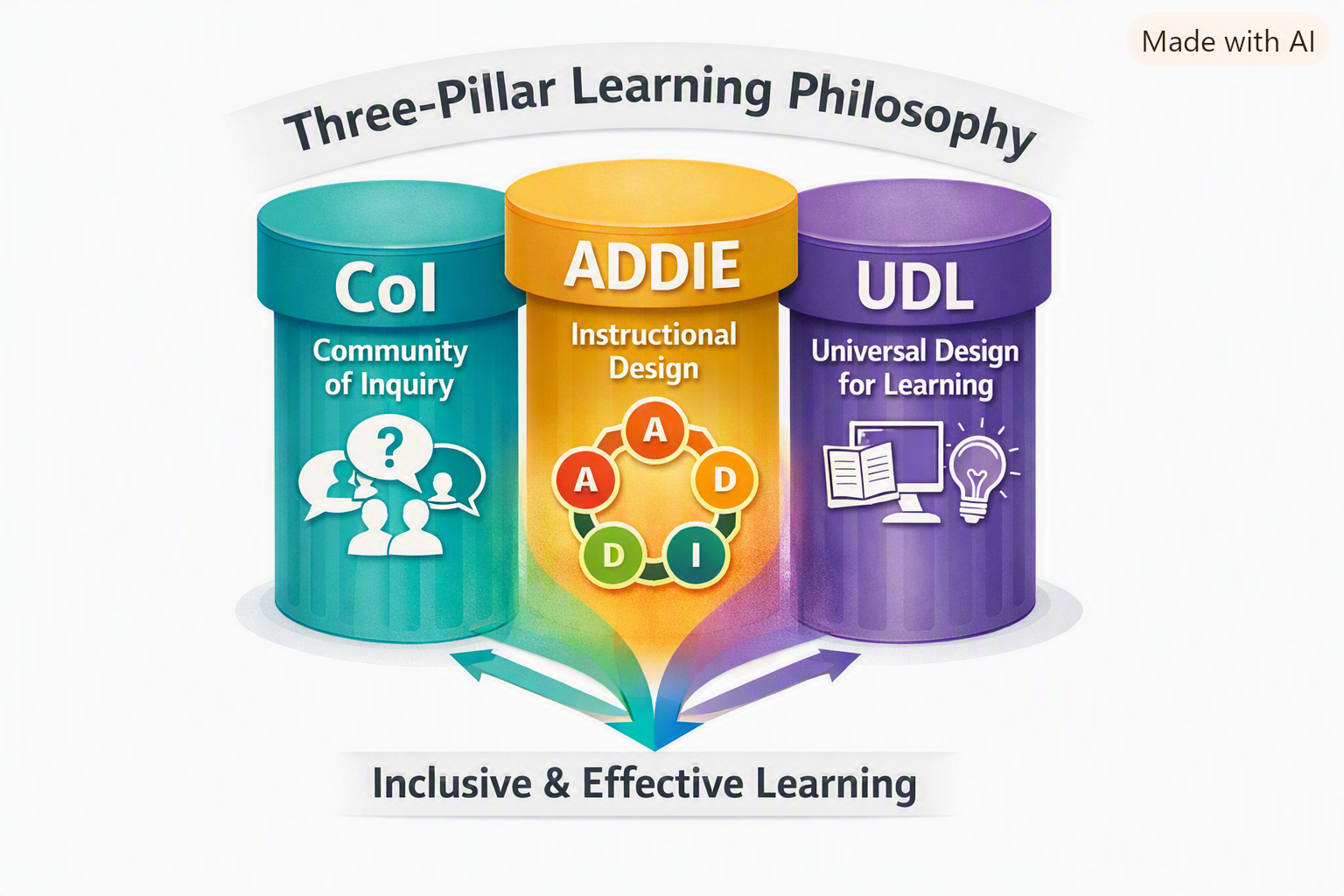
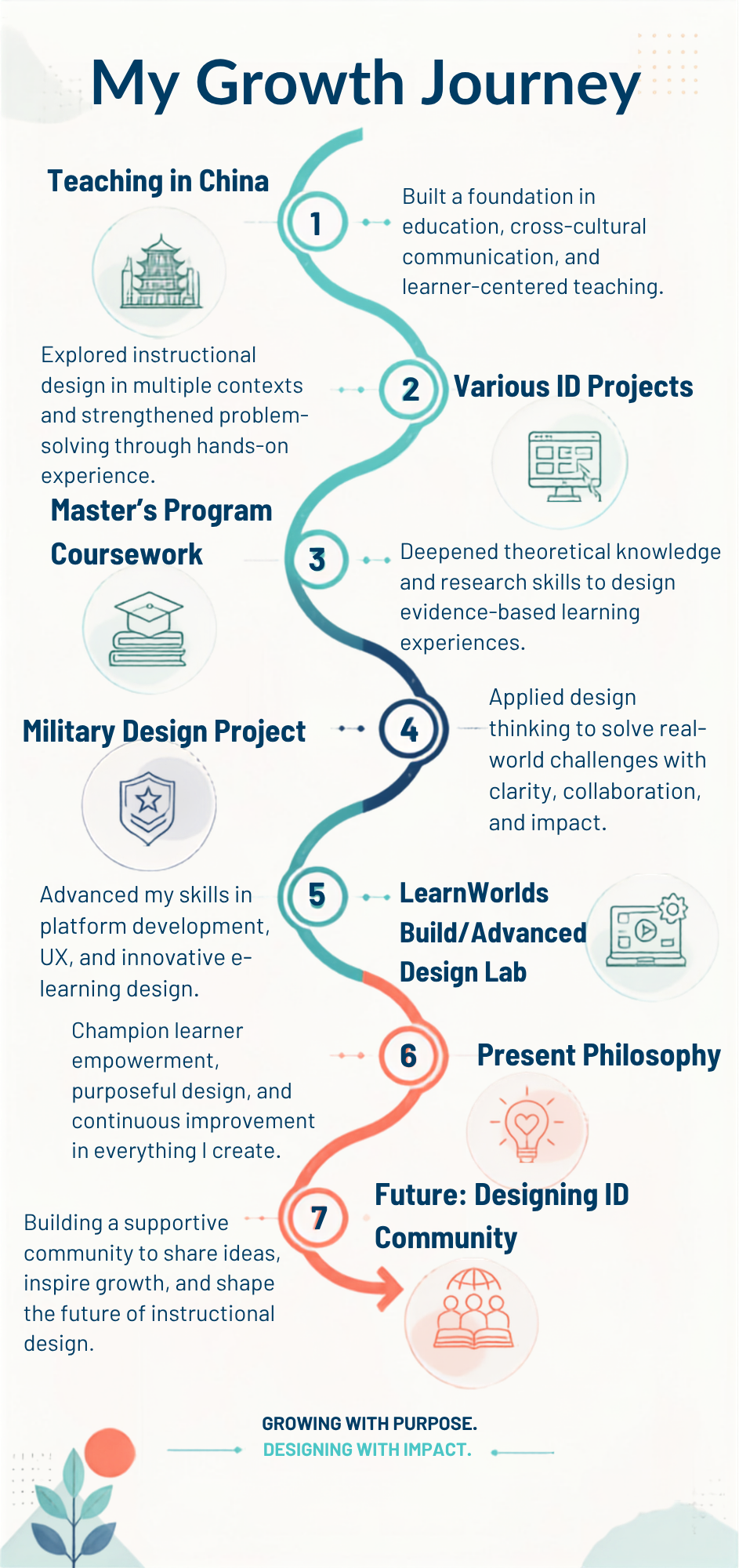
My philosophy of learning design and technology has been shaped by the interplay of theory, practice, and reflection throughout my career. As I have progressed through each design project, I have begun to see instructional design not simply as the creation of learning materials, but as an intentional, research‑informed process that centers accessibility, engagement, and learner agency. The theories and models I have encountered—particularly the Community of Inquiry framework, the ADDIE model, and Universal Design for Learning (UDL)—have become foundational lenses through which I design learning experiences. These frameworks helped me understand how to create learning environments that are structured, supportive, and responsive to diverse learners’ needs.
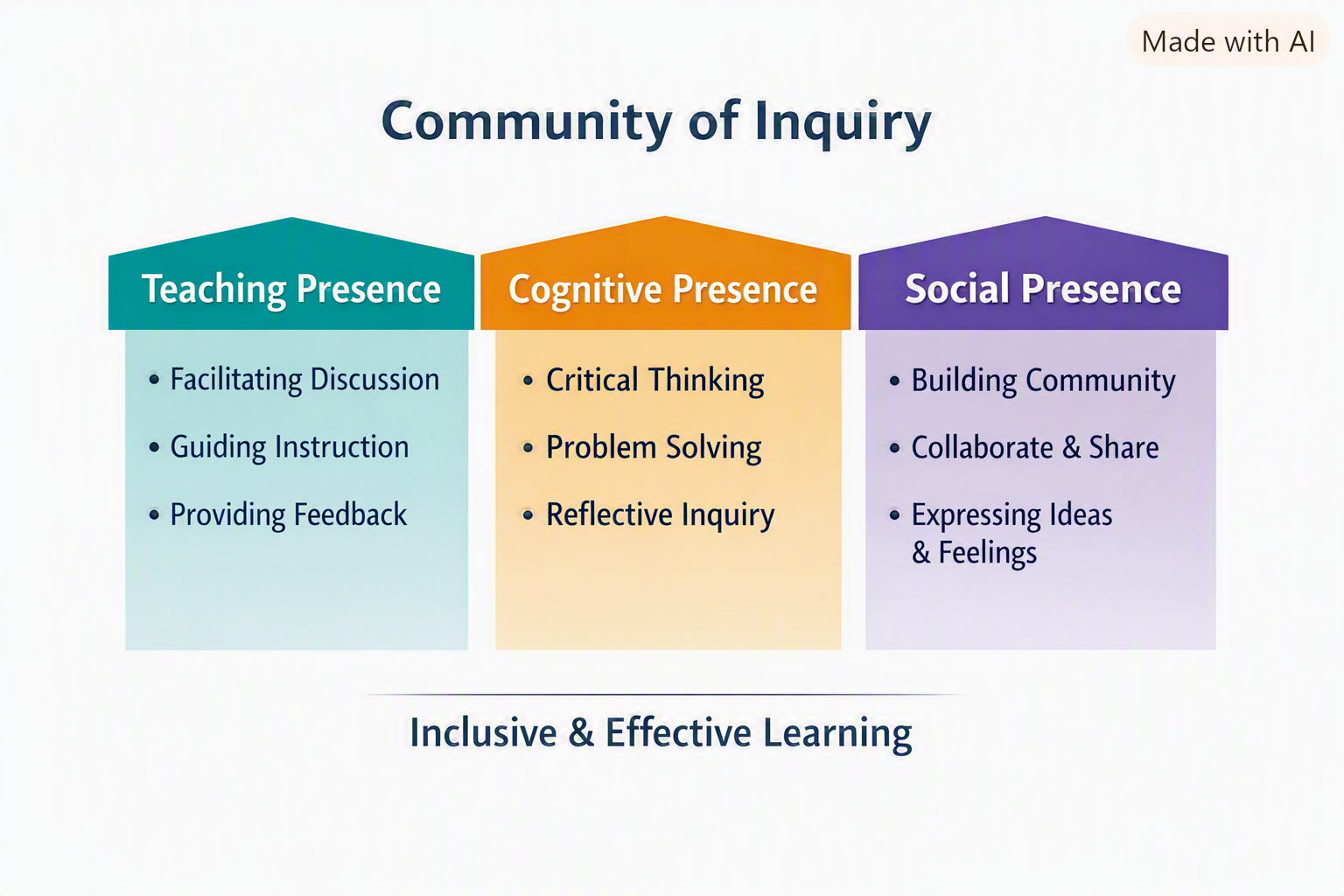
The Community of Inquiry framework (Garrison, Anderson, & Archer, 2000) shaped how I think about presence in online learning environments, and my customer service training project for my Master's Advanced Design Lab I class using LearnWorlds put all three of its elements to work.
Alongside the Community of Inquiry Framework, ADDIE gave my process its backbone. My course blueprint, media organization system, and cycles of iterative revision all followed ADDIE’s progression through analysis, design, development, implementation, and evaluation, which kept my projects clear and aligned even as they grew more complex.
Technology, in my approach, plays a strategic role rather than a decorative one—a solution to a specific instructional need, not a novelty added for its own sake. Across multiple projects, I have used AI tools to accelerate content creation, analyze learner responses, and help SMEs refine scenarios faster than manual review alone would allow. Research supports what I found in practice: AI increasingly functions as a co‑creative partner in instructional design, enhancing both efficiency and scalability rather than simply automating tasks (Qian & Hassan, 2025).
Project management platforms like Asana and structured SharePoint repositories kept multimedia files and deliverables consistently organized across teams. Every one of these choices reinforced the same belief: technology should follow the instructional need, not drive it.
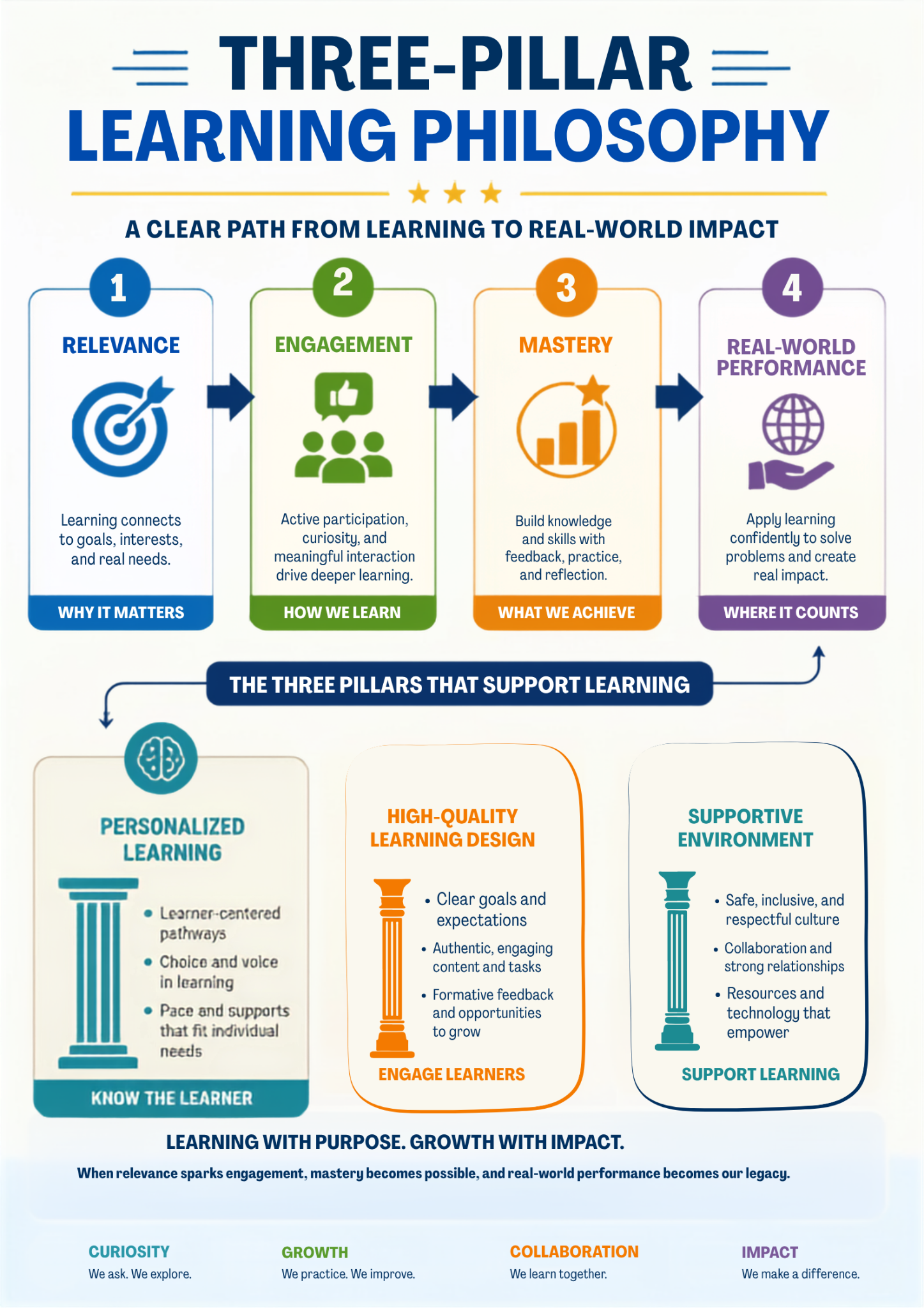
Mastery of any tool only happens when learners are genuinely engaged, and engagement rarely requires complex assessment so much as practical examples that mirror real experience. In my Advanced Design Lab, developing customer service training modules, I built formative, scenario-based, facilitator-led simulations with rubrics that established clear performance benchmarks—an approach I could later evaluate using frameworks like Kirkpatrick’s Levels of Evaluation.
Adult learning principles, including self-direction, relevance, and problem-centered learning, were built into each activity, and made learners self-motivated rather than compliance-driven, right from the start. My understanding of andragogy has shifted considerably since beginning my Master's of Education program. Before, I assumed adult learners were driven simply by wanting to finish a course or reach a high score. Now I understand that motivation is something adults bring themselves, when the work is realistic, relevant, and genuinely improves their ability to do their jobs. Current scholarship backs up that shift: even decades after its introduction, andragogy remains a widely applied framework precisely because its core assumptions about self-direction and relevance continue to hold up across fields of practice (St. Clair, 2024).
Across every project, a few patterns keep surfacing, and I've come to see them as my core values as a designer: organized learning objectives, realistic and practical activities that support authentic assessment, and accessibility built in from the very first design decision rather than added at the end.
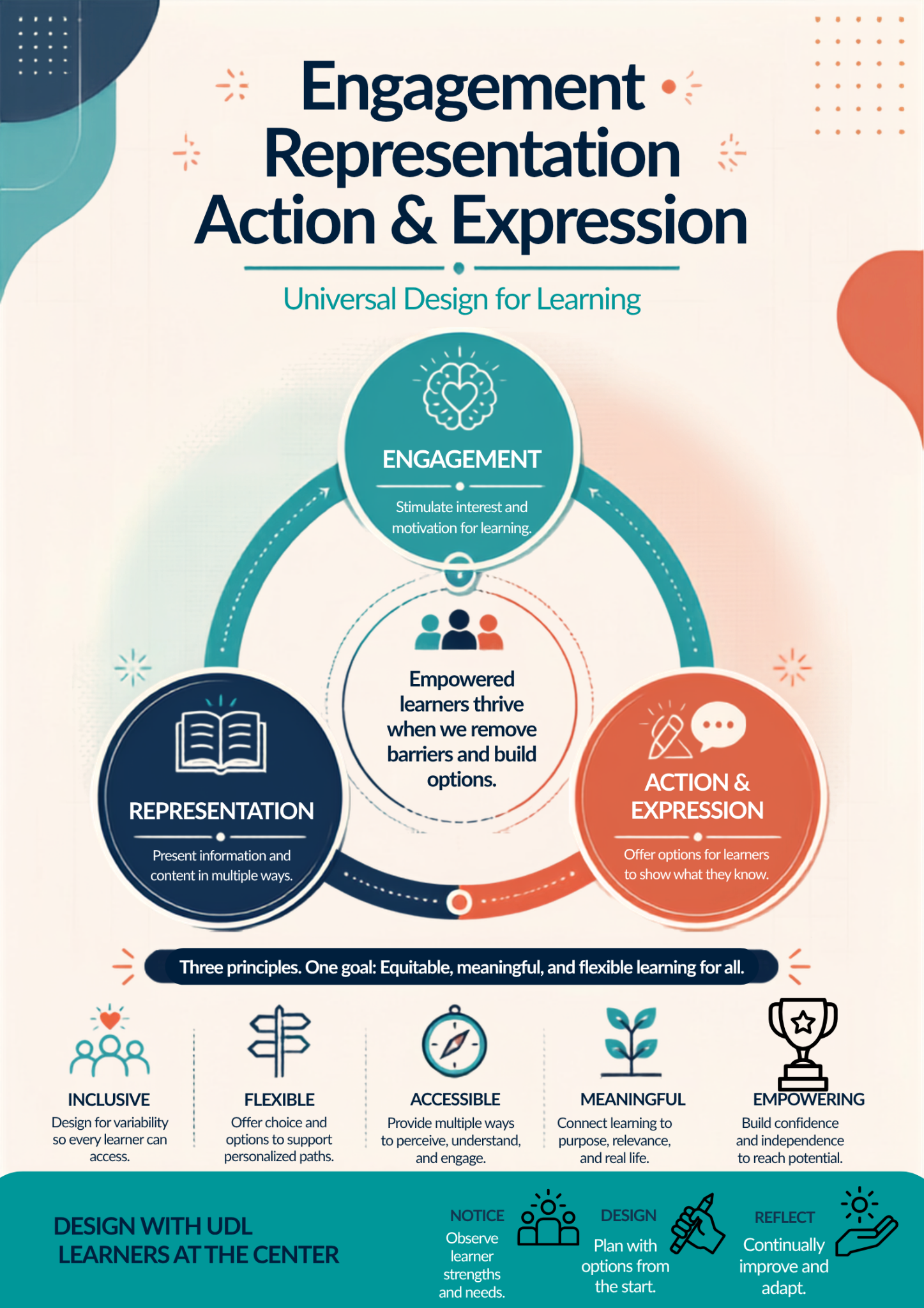
My accessibility plan ensures every resource meets WCAG 2.1 and Section 508 requirements, and it draws directly from Universal Design for Learning (UDL)'s requirement for multiple means of engagement, representation, and action and expression—so that materials are perceivable, operable, understandable, and robust across devices and assistive technologies from the start, not retrofitted once a course is already built.
Whatever I design next, I will carry that LearnWorlds design challenge with me—the reminder that a missing tool is never a reason to lower the bar, only a prompt to design around it more intentionally. This program strengthened my belief that instructional designers must be adaptable, curious, and willing to iterate quickly. My leadership has grown through navigating constraints, integrating emerging technologies, and designing learning experiences that remain grounded in theory while responsive to real-world needs.
I see myself not only as a designer, but as a problem-solver, collaborator, and continuous learner. I am someone who embraces change in the industry and uses it to build better, more accessible learning environments. My philosophy will continue evolving as technology, learners, and workplaces evolve, but its foundation will remain the same: learning should be organized, accessible, and genuinely engaging for every learner, regardless of platform or obstacle.
Garrison, D. R., Anderson, T., & Archer, W. (2000). Critical inquiry in a text-based environment: Computer conferencing in higher education. The Internet and Higher Education, 2(2–3), 87–105. https://doi.org/10.1016/S1096-7516(00)00016-6
Qian, Y., & Hassan, R. (2025). AI-integrated instructional design in higher education: A systematic exploration of tools, roles, and challenges. Contemporary Issues in Technology and Teacher Education, 25(4). https://citejournal.org/volume-25/issue-4-25/general/ai-integrated-instructional-design-in-higher-education-a-systematic-exploration-of-tools-roles-and-challenges
St. Clair, R. (2024). Andragogy: Past and present potential. New Directions for Adult and Continuing Education, 2024(184), 7–13. https://doi.org/10.1002/ace.20546
